
Talking Shop with Mark Dimaisip
Mark is back with two new poems, informed by his unique relationship to religion, queerness, and being a polyglot. Plus, we hear about an exciting Filipino zine project that he's involved with.
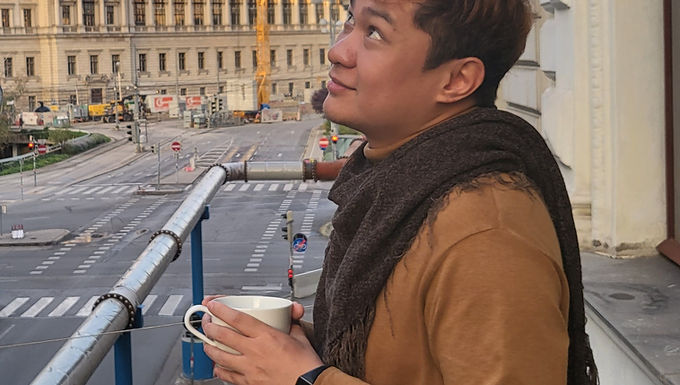
Mark Dimaisip is a Filipino writer from Manila. His works have appeared in The Brasilia Review, Cha, Fantasy Magazine, harana poetry, Human Parts, Oxford Brookes International Poetry Competition, Strange Horizons, and elsewhere. He has performed for poetry slams and literary festivals in Southeast Asia and Australia. Links to his poems are at markdimaisip.carrd.co.
Mark is the author of “Hunty Haikus for Holy Homosexuals” and “Every Name They Gave You” from Issue 11. He also published “The Experience Machine” in Issue 9, and “Loose Limits” in Issue 5.
Read his second interview with us from April 2025 here.
Read his first interview with us from Oct 2023 here.
Q: In a previous interview, you talked about working on a manuscript and finishing a chapbook. How was the journey so far?
I recently published my chapbook The First Bakla with Bente-Bente Zine (BBZ). It contains seven poems on mythmaking and reclamation, a queer cosmology grounded in Filipino cultural identity. The title poem retells my first encounter with a queer person, the first bakla that I know. And the other poems are anchored on that discovery.
Each BBZ zine is sold for only ₱20 (roughly 30–35 US cents), as a response to the lack of accessible and affordable literary materials in the Philippines. It allows artists like me to reach audiences who might otherwise never encounter my work or poetry. There's over 15,000 zines printed across several volumes and a good number was donated to public libraries.
I’m currently developing my next chapbook, where I try to reconcile my religious, conservative upbringing with my agnostic yet spiritual journey. I’m experimenting with liturgical forms: poetry in prayers, confessions, séances, exorcisms, and even reimagining and rewriting parts of the Bible through queer and scientific lenses. My poems “Hunty Haikus for Holy Homosexuals” and “Every Name They Gave You,” both recently published in Radon, are part of this ongoing manuscript.
Q: “Hunty Haikus for Holy Homosexuals” walks a tightrope between reverence and rebellion in the way that’s both playful and spiritual. How do you navigate writing about faith without falling into either satire or sanctimony?
While some may read it as satire or even sacrilege, my intent has always been inclusion. I want queer people to stop feeling fragmented. To stop thinking they must choose between their faith and their identity. I grew up in a conservative Catholic household and studied in Catholic schools, so my worldview was deeply shaped by religion.
Though I no longer identify as Catholic and now consider myself agnostic, I remain deeply spiritual. Many of my values are still rooted in Christianity. As a queer person, I question doctrine and explore it through art, but I don’t mock faith or call someone else’s belief invalid. For me, poetry is a way to imagine belonging. To create a space where faith and queerness coexist.
There are queer people who are deeply religious. And queer people who are struggling to reconcile faith and love. I want to tell them that they are not alone and that there is a space for us.
Q: During the writing process, what comes first for you: the image or the rhythm and sound of the line?
Always the image. My first draft of “Hunty Haikus” wasn’t even a haiku series—it began as a list of images describing an unapologetically queer person inside a church: entering in gold shoes, turning a rosary into a fashion statement, receiving signs of acceptance, a welcoming statue, a gay choir, a rainbow, and ending in a celebratory waack, one of the few dance step that I would least expect to see in a church.
When I noticed that many lines could stand on their own, I condensed and restructured them into a haiku sequence. The same happened with “Every Name They Gave You.” Before I wrote the first line, I saw the image of names stuck in one’s throat, then the collection of objects/memories, the ritual burning, and finally, cleansing and release.
Q: Echoing the title of “Every Name They Gave You,” what names have others given you throughout your life?
So many! But to give context—the Philippines isn’t as politically correct as most Western countries. I grew up in a mountainside community where disabilities, skin color, or misfortunes often became nicknames. Even when I moved to Manila at ten years old, parents teasing their effeminate sons or tomboy daughters was still common. I think that early exposure to language as both wound and endearment shaped how I write about identity today.
Q: Have you had an audience respond strongly, whether it be positively or negatively, to your poems?
In a past interview, I mentioned someone once told me my performance was boring. It stung, but it also became a turning point. I realized that spoken word isn’t just reading poetry aloud. It’s theater. The body, the voice, the gaze—they all carry meaning. That comment pushed me to think of performance as an embodied art.
My best experience was during a collaborative performance with musicians few years ago. By the end of the night, the entire bar had turned into a collective sobfest. Every table had someone crying. It was cathartic and electric. That kind of shared release reminds me why I write and perform because poetry can still move people toward empathy.
Q: The language of the poem moves fluidly between English, queer vernacular, and the musicality of Taglish rhythm. How conscious are you of linguistic hybridity when composing a piece like this?
I spent my early childhood in Passi, Iloilo, where we spoke a mix of Hiligaynon and Karay-a. At school, our classes were mostly in English. During school breaks, I stayed in Manila, speaking Tagalog. At home, we are mostly bilingual or trilingual, so code-switching became second nature.
When I write, I’m not fully conscious of linguistic hybridity. I don’t know if this happens to most polyglots but I feel that my brain encodes in different languages. So when it replays a memory or expresses a thought or distills an insight, it can come out mixed.
But sometimes I deliberately borrow foreign words like karoshi, or mamihlapinatapai, or skedonk. When I do, I read the poem repeatedly to ensure those words feel earned, not ornamental.
Q: What resonates with you about Radon? What does being a repeat contributor to the journal mean for you and the messages of your work?
What I love about Radon is its editorial care. The editors are not just gatekeepers that choose what gets published and what doesn’t. They’re also not just checking for grammatical errors or missing punctuation marks. They spend time with the writer to understand the potential of each piece and push them to greatness.
My first poem with Radon, “Loose Limits,” was so much different than what it turned out to be. From a list of seemingly absurd ways that nature would hoard in excess to a meditation that puts side by side physics, desire and capitalism. The same is true with my other poems.
For most literary magazines, they just take your poems for what they are. Radon invests in them and explores many ways it can grow.
Q: Could you share something about your original kernel of inspiration for your poem “Hunty Haikus for Holy Homosexuals”?
As a quiet but restless kid, I’d often get distracted during Sunday Mass, watching the people around me. I remember seeing trans women who refused to mute their presence in church: wearing bright feminine clothes, expressing joy. Some people would stare or whisper, but I loved that they still showed up.
That memory stayed with me. The poem imagines what it might feel like for them to finally receive signs of belonging. A rainbow through stained glass. A smile from the priest. And to celebrate that acceptance through movement, through dance, through joy.
Q: With your background in attending Catholic School and as we witness the rise of Christian Nationalism, what do you feel a piece like “Hunty Haikus” offers to combat that tide?
I don’t think direct confrontation always works. It often creates more division. When arguments fail, art offers another way.
I think of how the printing press and the rise of novels expanded empathy on a mass scale. How stories humanized the “other.” That’s what poetry can do and can still do. Storytelling reminds people, even those who think we shouldn’t exist, that we share the same griefs and desires and humanity.
We must still lobby, educate, and hold our institutions accountable. And we just continue to educate the immediate people around us, our families, our friends, even our elders. But art and poetry softens the ground where empathy can take root.
Q: Do you still find yourself trying to publish metered poetry, since our last conversation?
Definitely. My sonnets and villanelles and iambic pentameters are still disasters, but I’ve found comfort in forms closer to home—tanaga, sedoka, ghazal. “Hunty Haikus” is one of those recent experiments and I have a seance conversation in sedoka form, and a haunting in ghazal form coming out soon. I also plan to position these shorter more lyrical forms as breathers between my longer free verse and liturgical poems in my ongoing manuscript.
I still dream of writing a good sonnet one day. For now, I’m content with letting rhythm find its own prayer.