
Daniel Roop: Slam Poetry and Jetpacks
The "Jetpacks We Were Promised" author on his fear of heights, his spoken word albums, and how slam has evolved.
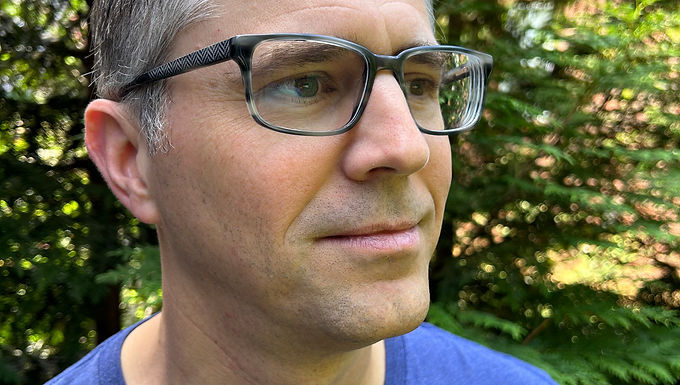
Daniel Roop is a member of the HWA and SFPA. His speculative work has appeared or is forthcoming in publications including Apex Magazine, Flash Fiction Online, Cast of Wonders, Cosmic Horror Monthly, and others. He finished in the top ten three consecutive years at the National Poetry Slam and has performed across the country including features at the Nuyorican Poets Cafe.
Daniel is the author of “The Jetpacks We Were Promised” from Issue 12.
Q: Your poem features unique use of white space. How did you decide on what the poem needed? And how do you decide between a standard indent and a different amount of empty space?
I’m concerned most of all with creating the rhythm and pacing that feels appropriate to the poem itself, and to each individual line. Do I want the reader to slow down? Do I want to propel them across the page, or from the end of one line to the beginning of the next? Do I want to specifically emphasize a word and let it sit for the briefest of moments? All spacing/indents are in service to that desired effect.
Q: What is your personal opinion on jetpacks?
Sadly, I’m afraid of heights, which I didn’t realize until we went on a family vacation two years ago to New River Gorge, and I got on a zipline. Bad way to figure out you’ve got a phobia.
Q: As a member of both SFPA and HWA, we are curious how you feel the horror community regards poets compared to the science fiction and fantasy portion of the industry?
I don’t know that I feel qualified to answer that in any comprehensive way, given that I’m relatively new to speculative writing (I started in 2023). I can say that I think the horror community is definitely supportive of poetry, and one of the highlights of the year for me is the annual HWA Poetry Showcase, which gives a great opportunity for HWA members to submit poems to a professional paying market, and produces a beautiful volume of well-crafted work for the community to sample.
Q: Tell us about the process of producing, releasing, and legacy of your 2001 spoken-word album, “The Ghost of Daniel Roop”?
I had moved to Crossville, TN at the time, with no local slam or poetry community, after being part of a vibrant community in Knoxville for years. I was traveling on weekends to Knoxville and Atlanta to perform and compete with a dear group of friends, writers who I deeply admired. Ayodele, Seed, Al Letson, and I qualified for the Atlanta Poetry Slam team competing in Seattle that year.
During that period, I bought time at a lovely local studio space in Crossville and recorded “The Ghost of Daniel Roop.” What matters most to me about that album is the people in my life as I was working on those poems—the influence we had on one another; how supportive we were of each other; the artistic excellence they all modeled. It was a joy to try to live up to the standard they set.
Q: What was the spark that pulled you toward poetry and, more specifically, slam?
I seem to have an inherent love for the sound of language, the games that can be played with it, and the physical and emotional effects it can produce. My favorite book as a child (and one of my favorites still) was Alice in Wonderland/Through the Looking Glass—for the whimsy, yes, but also for the songs, rhymes, and poems.
I also grew up with hip hop as my favorite music—the intensity, compression, and wordplay. That pulled me into poetry itself, and books like Aloud: Voices from the Nuyorican Poets’ Café, and In The Tradition: An Anthology of Young Black Writers (ed. by Kevin Powell and Ras Baraka) pulled me into slam.
Q: How has the slam scene evolved over the years, as someone who was so intimately involved?
I slammed regularly from 1995 to 2002, and have dipped back in sporadically over the years. I think one obvious change has been the wonderful emphasis on youth poets, with examples like the work Jeff Kass has done for decades at the VOLUME Youth Poetry Project in Ann Arbor.
The thing I loved most about poetry slam, and I’m sure this is still the same, is the sense of community. Poetry slam, for all its faults, and for all the reasonable criticism people might have, opened the world up for me. Pre-smartphone and social media, pre-internet omnipresence, slam connected me to a nationwide community of artists and writers, activists and scholars. It welcomed me and challenged me. It gave me immediate feedback on the work I was doing, and forced me to be accountable to the audience I insisted I wanted to reach.
Q: How do you prefer to build a world, or suggest one to readers, in the compressed space of poetry?
Such great questions! I think the word “suggest” is more applicable than the world “build,” for me, especially if we’re talking about sci-fi poetry. I find I really enjoy writing sci-fi poetry and flash fiction, but not so much longer sci-fi stories. With horror, I like both. I think it’s because I don’t enjoy elaborate, detailed, fully-fleshed out worldbuilding. It exhausts me. Instead, I love grounding things in our world, then tweaking some little thing, or adding one invasive element. In poetry, I can suggest a fuller world, and let the reader do however much lifting they wish to further imagine it.
Q: What does a typical writing session actually look like for you? Any rituals or habits?
For poetry, if I know I’m going to be writing later that day, I often like to prepare by listening to or reading something with intensely compressed language, something where every word and image has to carry weight. Haiku by modern poets or Issa. Charles Simic. Songs by MF DOOM or El-P.
When I’m actually writing, I just want silence. I don’t like holing myself up in a different room, so I usually sit in our kitchen, and let the joy and chaos of family life happen around me as the day goes. If I reach a point where things are flowing well and I know I need a solid block of uninterrupted time, I might put in ear plugs and let everyone know I need to focus for a while.
Q: Was there any music (1-3 songs) that you think would make a good mini-setlist for your poem? Either ones that may have been on your mind, or ones that give readers a good idea of the themes?
I’ve thought about this way too much and still don’t have a satisfying answer.
Maybe something like “Drones Over Brooklyn” by El-P for the opening techlord section. The girls/bicycle section should be joyful, yearning, and wistful at the same time, and would have to be something they might sing as they play—maybe something like “DtMF” by Bad Bunny.